Naga (Yuan-Ti, Snakefolk)
- Home Plane
- Vitaea
- Category
- Seaborn
- Ancestor Race(s)
- Sylvari-Vitae (True Sylvari)
- Home Region
- Eskelieh
- Racial Abilities
- Intelligence, Dexterity
- Racial Features
- Cold-Blooded, Cold-Blooded Intrigue, Serpentine Spellcasting, Poison Resilience, Venomous Bite, Constrict, Serpentine Body
- Years of Existence
- 40,000 years
- Average Lifespan
- 100 years
- Average Weight
- 150 lbs
- Average Height
- 6 ft (12ft length)
- Skin Tones
- Greens, Blues, Blacks, Purples
- Playable?
- Yes
- Extinct?
- No
- Size Category
- Medium
- Speed
- 25
- Movement Types
- Swimming, Walking
- Hair
- Scaled
- Body Features
- Snake-folk Humanoid, Legless, Tailed
- Divergence Cause
- Great Awakening
- Average Generation
- 20 years
- Vision Type
- Low-light Vision
- Vision Distance
- Unlimited
- Short Description
- An authoritarian theocracy of snake-folk known for their cold-blooded court intrigue and a strong hatred for other races
- Languages
- Aethyrian Common, Yuantish
- Default Upbringing
- Communal: Raised by a village, order, or organization
Full Description
Ye cannot goad one of the serpent folk into hatred or fear, or evoke in it love or friendship. They may feign such things to cozen ye, but within they are always coldly, calmly calculating.
— Elminster
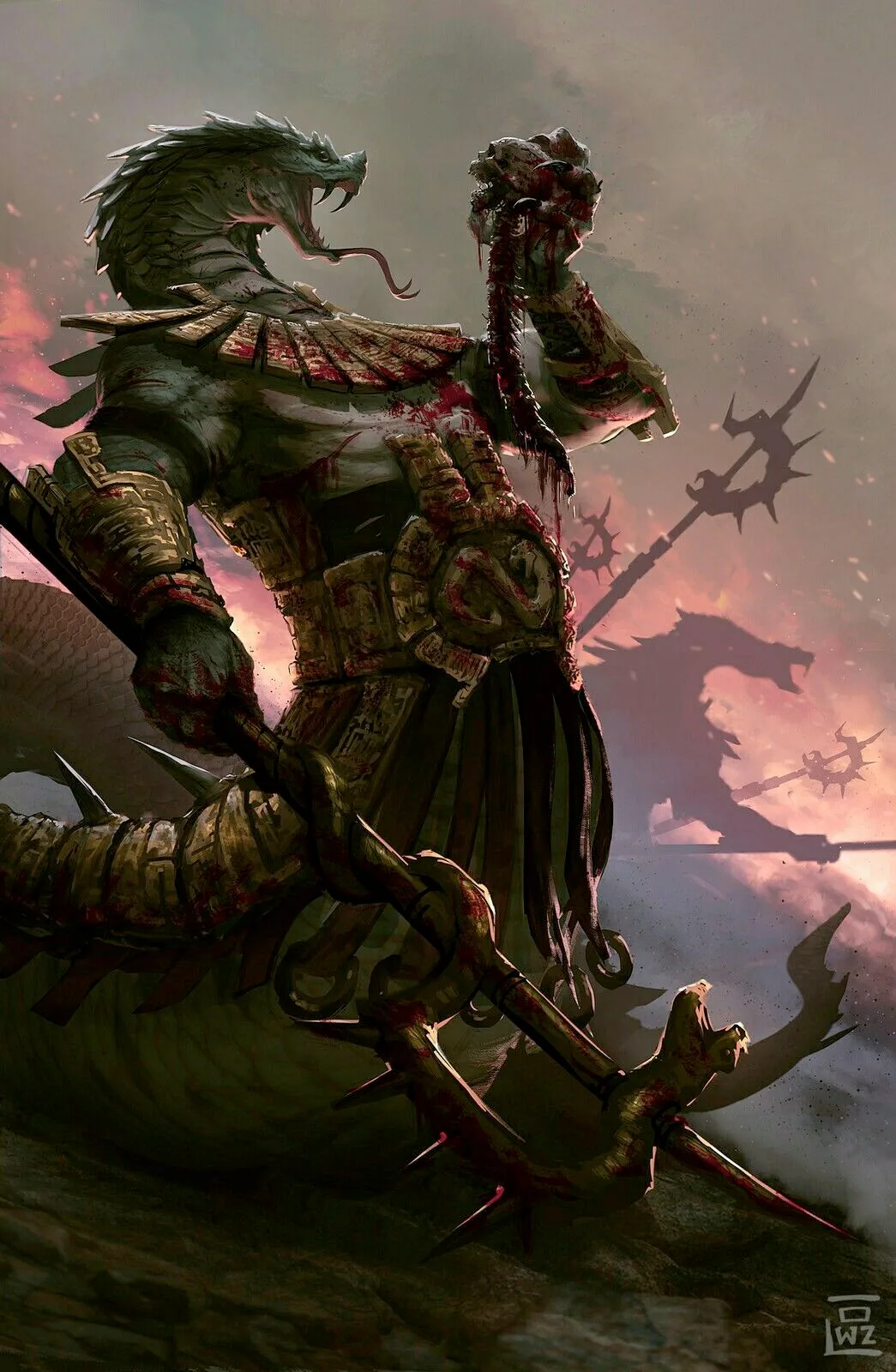
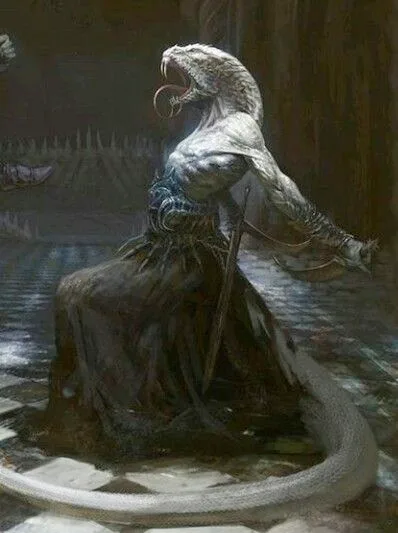
The serpent creatures known as naga are all that remains of an ancient, decadent serpent empire. Ages ago, in the earliest days following the Great Awakening, their priest-philosophers uncovered profane rites that reshaped their bodies and minds, refining themselves into a caste-based society of perfected forms in which the most serpentine are the leaders and the most outwardly humanoid are spies and agents in foreign lands.
Serpents Awakened
The serpents who became naga were among the earliest awakened civilizations of Vitaea. Their society built great temples of stone and forged metal into armor, tools, and weapons. In their ceremonies they paid homage to the serpent as the embodiment of the qualities they most appreciated.
They developed a philosophy of separating emotion from intellectual pursuits, allowing them to focus their energy on personal advancement and expanding their territory. They believed themselves to be the most enlightened mortals in the world, and in their hubris they sought to become ever greater.
In time, their devotion to the ophidian ideal turned inward. Through ritual, sacrifice, and the manipulation of Aethyr, they learned not merely to honor the serpent—but to become more perfectly aligned with it.
One Race, Many Forms
The bodies of all yuan-ti have a mix of humanoid and snakelike parts, but the proportion varies from individual to individual. After the initial metamorphosis from serpents, their society quickly coalesced into a caste system based on how complete a person’s transformation was. The vast majority of yuan-ti fall into three categories — abominations, malisons, and purebloods — while the mutated broodguards and exceedingly rare anathemas have their place in the hierarchy as well.
All yuan-ti can interbreed. Females usually lay clutches of eggs, which are stored in a common hatchery, although live births aren’t uncommon. A mating between yuan-ti of different types almost always produces eggs that hatch into yuan-ti of the weaker parent, so most choose partners of the same type in the interest of maintaining the strength of their personal bloodline.
The yuan-ti know rituals that can transform an individual into a more powerful type. The cost and time required to perform the ritual is prohibitive, and as a result most yuan-ti never get the opportunity to undergo such a transformation. Every use of the ritual must be modified to suit the individual undergoing transformation, and requires rare herbs, exotic magical substances, snakes, and one or more mortals to be sacrificed and eaten as part of the procedure.
Undercover Empire
The civilization that gave rise to the naga was among the richest in the mortal world. It rapidly progressed in metalworking, using keen intellect and magic to discover the secrets of making steel. Its military shattered rival tribes and developed advanced tactics for fighting in forests and open plains.
The civilization grew into a cluster of allied city-states. Conquered neighbors were allowed to keep their leaders and culture so long as they paid tribute, swore allegiance to the victors, and incorporated their conquerors’ serpent doctrines into their beliefs. These victories sent a constant influx of food, ore, and slaves back to the home cities.
The wealth of the empire allowed the ruling elite plenty of time to focus on intellectual pursuits. These nobles turned to philosophy and ritual, offering magic and sacrifice in pursuit of the perfection of the ophidian form. In time, they discovered how to reshape themselves into that ideal—but the cost of the change was high, requiring many sacrifices for each individual transformation.
Entire populations of captives in one city-state were consumed to fuel the first great ascensions, and once the knowledge of these rites spread to other leaders, the demand for sacrifices grew without limit. As the rites demanded more and more living essence, the naga intensified their raids on bordering settlements to sustain their transformation.
Calm long-view schemers, innate deceivers, and immune to poison — yuan-ti make perfect courtiers. And, worse for the rest of us, rulers.
— Elminster
The physical and magical prowess of the naga empire allowed them to retain their holdings for several hundred years, until a combination of drought, attacks by enemies (including dragons and rival awakened beings), civil war, torpor among their guiding doctrines, and the rise of iron weapons among their enemies finally loosened their hold over nearby lands.
The naga withdrew to their fortified cities and underground temples, ceding the rest of their territory to their former subjects. They vanished in a matter of weeks, all but disappearing from the world.
Naga structures throughout the land were torn down to celebrate liberation from the serpent-bodied oppressors, and within a few generations the naga were all but forgotten by the emerging civilizations of Vitaea.
For over a thousand years after their empire fell, the naga remained ensconced in their hidden strongholds, biding their time until they were ready to strike again.
Today, with their numbers greatly diminished and their enemies much stronger than in ages past, the naga know they cannot rely on open conquest to reclaim their dominance.
Instead, operating from subterranean ruins and hidden enclaves, naga agents infiltrate foreign governments to discover weaknesses that their leaders can exploit. They look forward to the day when their dominion spreads across the world like venom through the blood, as it once did.
Because their population is so small, the naga avoid open warfare. Instead, they gain influence by controlling rulers—and those close to them—through blackmail, drugs, magic, and subterfuge carried out by disguised purebloods.
“From the deep jungles and along the trade routes, naga poisons and potent liquors are quietly sold. Beware—some of these brews bind the will of those who partake, leaving them open to the influence of the next serpent-spy they encounter.”
— Elminster
Emotionless Evil
During their ascension, the naga stripped themselves of emotional influence. Now they view the world from a pragmatic and dispassionate perspective. They understand emotional connections in a detached, intellectual way, and recognize that such feelings in others can be exploited through bribes, favors, or threats.
As creatures devoid of emotion, yuan-ti exhibit behavior and use tactics that exemplify that outlook (or lack of one). Whether in combat or in daily life, the following principles guide the yuan-ti in all they do.
Other Lives Are Cheap
Yuan-ti put little value on humanoid lives, even those of their own slaves and cultists. They would poison children to carry out a threat against their parents, or turn one person into a broodguard in order to show her family the consequence of resistance. They might refrain from provoking others’ feelings if doing so could adversely affect the yuan-ti’s plans, but they understand humanoid psychology well enough to know that they can get away with this casual disregard for life almost anytime.
Furthermore, in the yuan-ti caste system, a greater yuan-ti’s life is worth far more than a lesser one’s. Weaker citizens are expected to lay down their lives to protect their betters. Leaders rely on this zealotry in their plans, and although they don’t needlessly waste the lives of purebloods on futile actions, most strategies include a fallback option in which mobs of purebloods and slaves are thrown at opposing forces in the hope of allowing the malisons and abominations time to escape.
Survival First
Yuan-ti are likely to retreat or flee from conflict if they don’t believe they have a reasonable chance of success. This reaction isn’t out of cowardice, but practicality—yuan-ti value their own lives much too highly to risk them when the odds aren’t in their favor. A short retreat might be just the thing to reach a better tactical position, find allies, or to allow the yuan-ti the opportunity to study their opponents and implement better tactics. Any enemy who chases a group of fleeing yuan-ti might be on the victorious side of a rout or could be heading into a trap; if the enemy has been encountered before, it is likely that the yuan-ti have prepared a special ambush at the end of the pursuit.
Capture, Not Kill
The objective of the yuan-ti as a race is to conquer and enslave others; they don’t espouse the sort of evil that calls for them to butcher or eradicate all who oppose them. In keeping with their goal of domination, the yuan-ti would rather capture potentially useful opponents than kill them. They use many methods for capturing enemies, such as poisoning, knocking out an opponent instead of making a killing blow, throwing nets, using magic such as suggestion, or restraining them in the coils of a giant snake.
To force their compliance, enemies might be brainwashed, charmed, tortured, or transformed into broodguards. Those that prove intractable still have their uses, either as sacrifices to the gods or as food.
Depend on Deceit
Naga have no sense of honorable combat. They are naturally stealthy, and if they can sneak up on enemies, either in an ambush or to murder them in their sleep, the yuan-ti will do so—and they actually prefer these tactics to open warfare. Because abominations and malisons can change into the shapes of snakes, they can keep their presence hidden and get into places their normal forms couldn’t enter.
Their immunity to poison gives all yuan-ti a tactical advantage in dealing with other creatures. A pureblood serving as a food taster for a royal family could poison a meal and declare it “safe” after taking a bite.
“There are tales of serpent folk hidden within the courts of great cities—merchants, advisors, even rulers themselves. I find such stories difficult to believe.”
— Volo
“Ye should.”
— Elminster
Roleplaying a Naga
When you’re roleplaying a Naga, the following tables contain possible inspiration. They suggest characteristics that a yuan-ti might possess.
Naga Personality Traits
| d8 | Personality Trait |
|---|---|
| 1 | I see omens in every event and action. The serpent gods continue to advise us. |
| 2 | I have very high standards for food, drink, and physical pleasures. |
| 3 | I prefer to be alone rather than among other creatures, including my own kind. |
| 4 | I sometimes become consumed by philosophy. |
| 5 | I believe I am superior to others of my caste. |
| 6 | I am driven by wanderlust and want to explore lands far from our cities. |
| 7 | I am interested in modern human culture, even as primitive as it is. |
| 8 | I await the day when we again conquer lands by force, as we did in the old times. |
Naga Ideals
| d6 | Ideal |
|---|---|
| 1 | Greed. I display my wealth as a sign of my power and prosperity. (Evil) |
| 2 | Aspiration. I strive to follow the path toward becoming an anathema. (Evil) |
| 3 | Unity. No leader shall put personal goals above those of our race. (Any) |
| 4 | Kinship. My allegiance is to my caste and my city. Other settlements can burn for all I care. (Any) |
| 5 | Inspiration. My actions set an example for the lesser castes to emulate. (Any) |
| 6 | Power. Everything I choose to do is determined by whether it will make me smarter and stronger. (Evil) |
Naga Bonds
| d6 | Bond |
|---|---|
| 1 | I will see our empire rise again and, in so doing, win the favor of the serpent gods. |
| 2 | I am enamored with the culture and trappings of another society and wish to be part of it. |
| 3 | I respect my superiors and obey them without question. My fate is theirs to decide. |
| 4 | I have an interest in an unsuitable mate, which I can’t suppress. |
| 5 | I respect and emulate a great hero or ancestor. |
| 6 | An enemy destroyed something of value to me, and I will find where it lives and kill the offender. |
Naga Flaws
| d6 | Flaw |
|---|---|
| 1 | I feel twinges of emotion, and it shames me that I am imperfect in this way. |
| 2 | I put too much credence in the dictates of a particular god. |
| 3 | I frequently overindulge in food and wine, and I am impaired and lethargic for days afterward. |
| 4 | I worship a forbidden god. |
| 5 | I secretly believe things would be better if I was in charge. |
| 6 | If I could get away with it, I would gladly kill and eat a superior yuan-ti. |
Naga Names
Naga names have meanings that have been passed down through the generations, although spellings and inflections have changed over time.
Some naga add more sibilants to their birth names to create an exaggerated hissing sound, based on one’s personal preference and whether an individual’s anatomy can more easily pronounce the name in this altered form. An adopted name of this sort is recognized as a variant of the birth name, rather than a unique name unto itself. A naga might refer to itself by its birth name, by its adopted name, or (especially among purebloods) by a name it borrows from the local populace.
The Naga Names table provides naga birth names suitable for any campaign.
Naga Names
| d20 | Name |
|---|---|
| 1 | Asutali |
| 2 | Eztli |
| 3 | Hessatal |
| 4 | Hitotee |
| 5 | Issahu |
| 6 | Itstli |
| 7 | Manuya |
| 8 | Meztli |
| 9 | Nesalli |
| 10 | Otleh |
| 11 | Shalkashlah |
| 12 | Sisava |
| 13 | Sitlali |
| 14 | Soakosh |
| 15 | Ssimalli |
| 16 | Suisatal |
| 17 | Talash |
| 18 | Teoshi |
| 19 | Yaotal |
| 20 | Zihu |