Wagbalag Wug (Bullywug)
- Home Plane
- Vitaea
- Category
- Landborn
- Ancestor Race(s)
- Sylvari-Vitae (True Sylvari)
- Home Region
- Akaras Wilds
- Racial Abilities
- Wisdom, Constitution
- Racial Features
- Amphibious, Standing Leap, Speak with Frogs and Toads, Natural Camouflage, Tongue Lash, Amphibian Acrobats, Slippery Hide
- Years of Existence
- 40,000 years
- Average Lifespan
- 50 years
- Average Weight
- 50 lbs
- Average Height
- 3 ft
- Skin Tones
- Greens, Browns, Blacks
- Playable?
- Yes
- Extinct?
- No
- Size Category
- Medium
- Speed
- 30
- Movement Types
- Swimming, Walking
- Hair
- Hairless
- Body Features
- Toad-folk Humanoid
- Divergence Cause
- Great Awakening
- Average Generation
- 10 years
- Vision Type
- Normal
- Vision Distance
- Unlimited
- Short Description
- A humanoid toad-kin which live in republican settlements in marsh and swamplands
- Languages
- Aethyrian Common, Wagbalag
- Default Upbringing
- Communal: Raised by a village, order, or organization
Full Description
Bullywugs are a race of amphibious toad-people residing predominantly in swampy and marshland areas. Standing between 4 to 5 feet tall, they exhibit a variety of mottled green, brown, and yellow hues on their moist, slimy skin, providing natural camouflage among the vegetation of their habitats. Their large, bulbous eyes come in shades of gold, copper, or red, granting them excellent night vision.
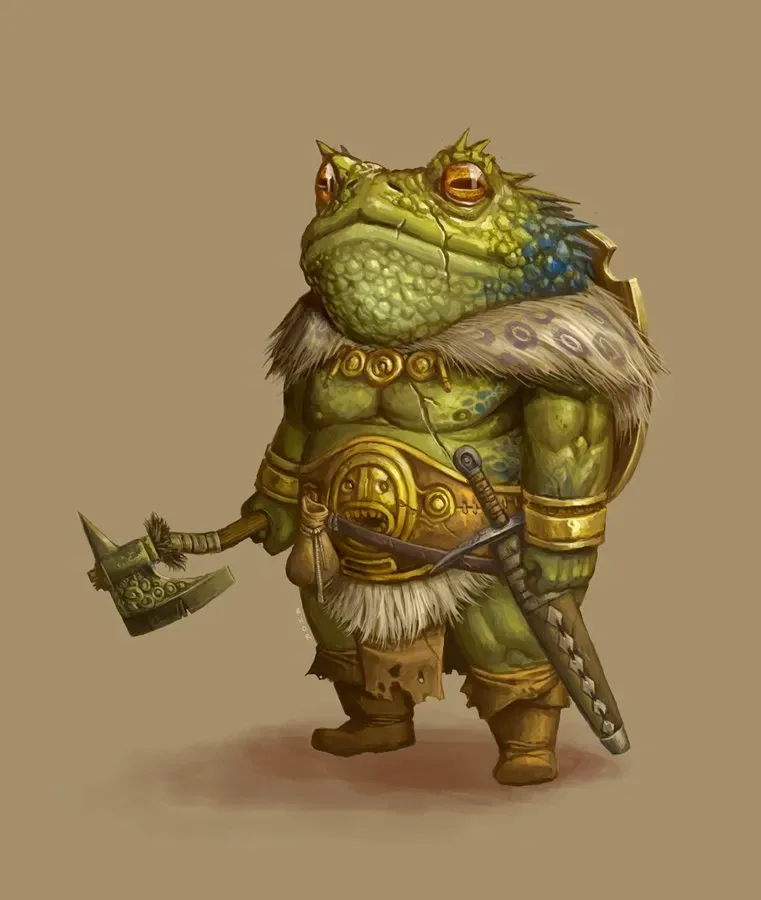
Nature: Bullywugs are territorial and opportunistic creatures. They tend to be quite aggressive, especially when defending their homes or competing for resources. Despite their sometimes menacing demeanor, Bullywugs are adept survivalists, utilizing their environment to its fullest potential and adapting swiftly to changes. Their agile limbs and strong legs aid in swift swimming and powerful leaping, while their long, sticky tongues serve as versatile tools and weapons.
Culture: Bullywug society is organized into tribes, each governed by a chieftain who is often the strongest or most cunning member of the group. The chieftain's word is law, and disputes within the tribe are settled through challenges or trials dictated by the leader. Bullywugs value strength, resourcefulness, and adaptability, with members of the tribe proving their worth through hunting, gathering, and defending the territory.
Religious practices among Bullywugs often revolve around the worship of deities associated with water, nature, and fertility. Rituals and ceremonies are performed to appease these deities and seek their blessings for abundant resources and protection from predators.
Lifestyle: Living in swampy environments, Bullywugs construct their homes from readily available materials such as mud, reeds, and vines. These dwellings are strategically placed for defense and access to resources, often featuring hidden escape routes underwater.
Bullywugs are omnivorous, subsisting on a diet of insects, fish, small mammals, and aquatic plants. Hunting and gathering are communal activities, with the fruits of the labor shared among the tribe. Their connection to the swamp environment makes them adept herbalists, utilizing various plants for medicinal and practical purposes.
Bullywugs are known for their distinctive vocalizations, using a series of croaks, ribbits, and clicks to communicate with each other. This language, known as Bullywug, is challenging for non-Bullywugs to comprehend and mimic due to its unique tonal and rhythmic qualities.
Relations with Other Races: Bullywugs are generally distrustful of outsiders, often viewing them as potential threats or competition for resources. However, they can form tenuous alliances with other races if mutual benefits are evident. They are known to trade with nearby settlements, exchanging herbs, fish, and swamp resources for tools and goods unattainable in their environment.
Adventurers: Bullywug adventurers are rare but not unheard of. Driven by the desire for resources, territory, or personal power, these individuals may venture beyond the swamp in pursuit of their goals. Bullywug adventurers are versatile, possessing skills in stealth, survival, and combat, making them valuable assets to adventuring parties, despite their often brusque and territorial nature.