The War of the Moon
Prelude: The Era of Convergence
Section titled “Prelude: The Era of Convergence”For millennia following The Rending, Aradaea and Vitaea were the only major celestial bodies in each others’ skies. To the inhabitants of these worlds, the distant planet visible above was often mistaken for a moon, believed to be a celestial realm where their gods resided.
This perception persisted until the dawn of the Neoteric Timeline (modern-time) roughly 2,500 years ago. As civilizations on both planets advanced, so too did their understanding of the Aethyrweave and the broader cosmos. Early researchers, arcanists, and diviners from the most developed cultures began to question their ancient beliefs, leading to a monumental discovery: the celestial body they had long revered as a moon was, in fact, another planet teeming with life.
This revelation sparked a surge of interest in exploring the skies, which eventually led to the first contact between the sapient beings of Aradaea and Vitaea. This new understanding ushered in a rapid development in magical studies and led to the critical discovery that mortality’s increased use of Aethyr was drawing the twin planets closer together at an alarming rate.
The Era of Division
Section titled “The Era of Division”As the planets drew nearer, tensions began to rise. The looming threat of a planetary collision sparked a fierce debate among the races of both worlds. This period, known as the Era of Convergence, saw a schism between two factions:
• The Traditionalists: These groups viewed the use of magic as an affront to their ancient beliefs. They saw the impending collision as a divine warning, demanding that all magical practices cease immediately to avoid divine retribution. • The Aethyrists: In contrast, the Aethyrists believed that only magic could prevent the catastrophe. They argued that halting magical practices would do nothing to reverse the damage already done and that the only solution lay in harnessing Aethyr to stabilize the planets.
The ideological divide between these factions led to widespread conflict. Wars erupted as Aethyrists sought to develop a magical solution, while Traditionalists fought to stop them. As the planets grew larger in each other’s skies, despair and nihilism spread among the populace, with many fearing the inevitable destruction of their worlds.
The Creation of Ravena
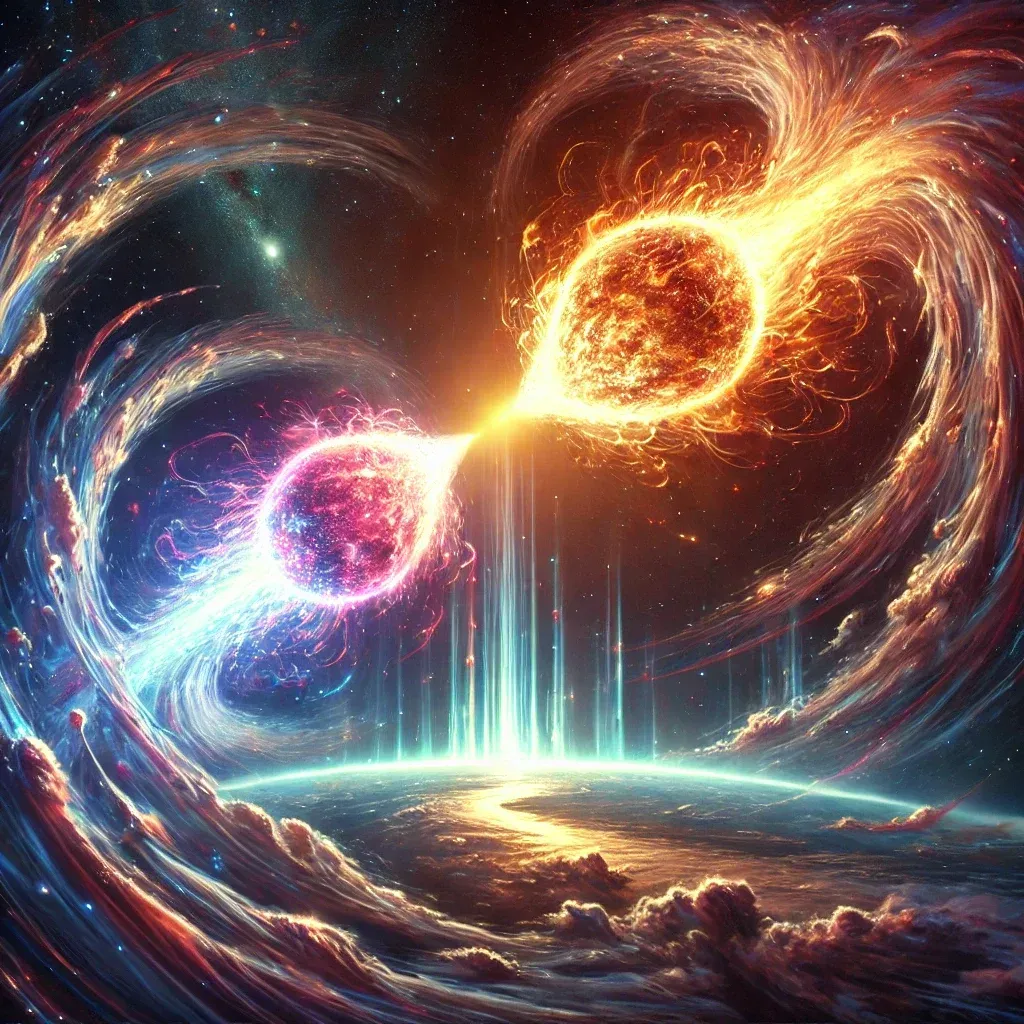
Section titled “The Creation of Ravena”Amidst the chaos, a coalition of the most magically advanced civilizations from both planets came together in a desperate attempt to avert disaster. They devised a plan to create an Aethyr-fusion reaction that would stabilize the attraction between Aradaea and Vitaea. This involved extracting vast quantities of Aethyr-rich minerals from both planets, forming them into two immense arcane comets, and hurling them at each other to collide between the twin planets.
The endeavor was fraught with peril, as Traditionalist forces sought to sabotage the effort. The immense use of Aethyr nearly brought the planets into collision, but in a final, sky-shattering display of magical force, the comets collided and created Ravena — a new moon that stabilized the planets’ orbits and prevented their destruction.
The War of the Moon
Section titled “The War of the Moon”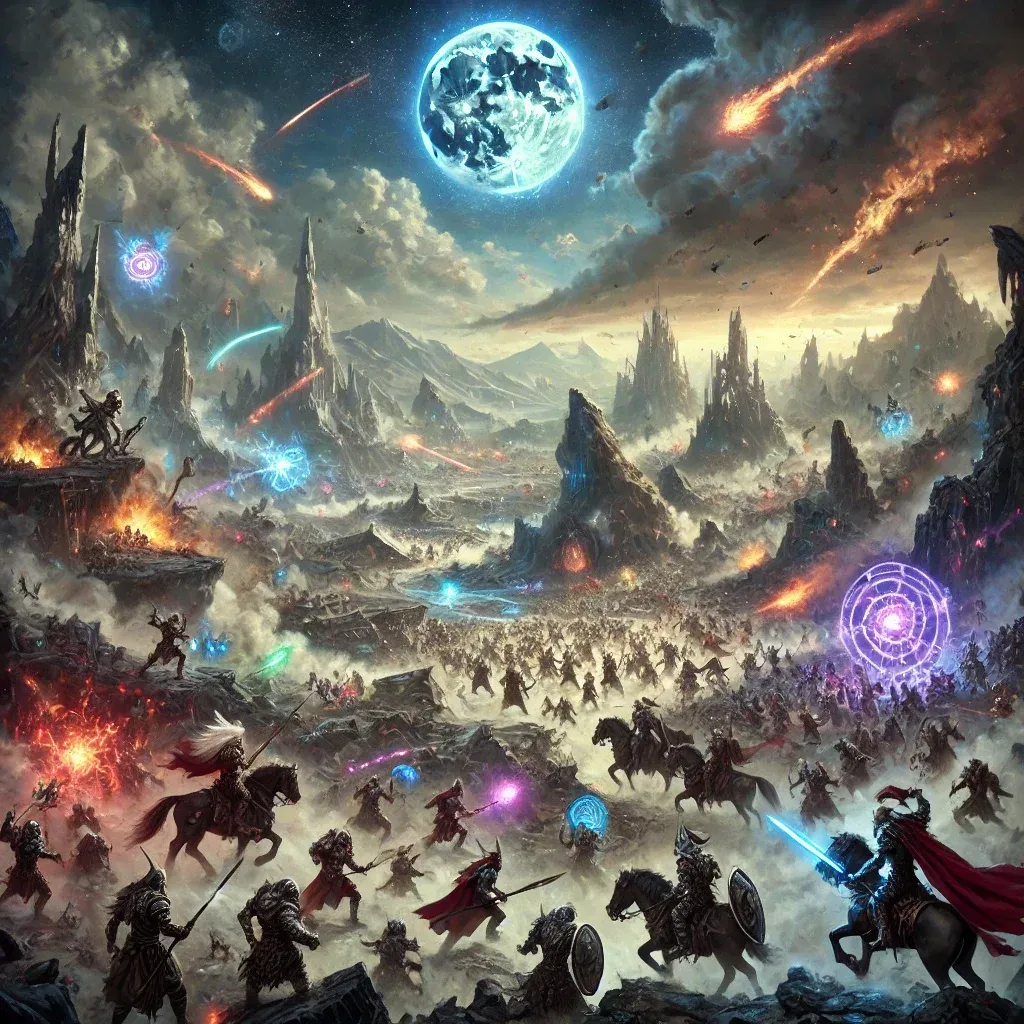
A New Battleground
Section titled “A New Battleground”In the years following Ravena’s creation, the fervor of Traditionalist sentiment waned, and mortals once again turned their attention to the possibilities offered by magic. However, the creation of Ravena had come at a cost: the strength of magic on both planets began to wane due to the massive Aethyr extraction.
Determined to unlock new magical knowledge and capabilities, mortals began to explore Ravena, eager to tap into the potent magical energies of its Aethyr-fusion core. This sparked a frantic race to land on the moon and stake claims on its resources. As more and more expeditions reached Ravena, the races of Aradaea and Vitaea met face-to-face on its surface, often for the first time.
What began as a scramble for resources quickly escalated into a full-blown conflict. The War of the Moon was a brutal, century-long struggle that saw the surface of Ravena ravaged by battles of unprecedented scale. The potent Aethyr energy of the moon fueled devastating spellwork, and the conflict reached heights of destruction not seen since the God Wars of Terra that ended in The Rending.
The Treaty of the Guildpact
Section titled “The Treaty of the Guildpact”As the war raged on, signs began to emerge that the very stability of Ravena was at risk. The continuous drain on the moon’s Aethyr core threatened to destabilize it, potentially undoing the delicate balance that had saved the twin planets. Fearing mutual destruction, a coalition of concerned mortals formed from several of the belligerent factions.
This coalition worked tirelessly to negotiate peace and eventually succeeded in bringing an end to the conflict. The war concluded with the signing of the Treaty of the Guildpact, a historic agreement that established Ravena as a neutral territory, belonging to all of Geminaea’s peoples. A confederacy of guilds was created to govern Ravena, ensuring that it remained separate from the worldly politics of Aradaea and Vitaea.
Ravena and the Lunar Era
Section titled “Ravena and the Lunar Era”With the war over, Ravena began to develop into a thriving hub of commerce, culture, and politics. Over the past 2,000 years, it has grown into a vast megalopolis, serving as a nexus that connects Aradaea and Vitaea more closely than ever before. A reliable mode of transport between the planets and the moon was developed, enabling travel across all three celestial bodies and fostering a new era of interconnectedness.
As Ravena’s influence grew, so did the migration of peoples from both planets to settle closer to the planetary ports. On Aradaea, southern settlements were gradually abandoned, while on Vitaea, the northern civilizations were reclaimed by the jungles as mortals sought the benefits of being near the heart of their world.