Demographics & Population
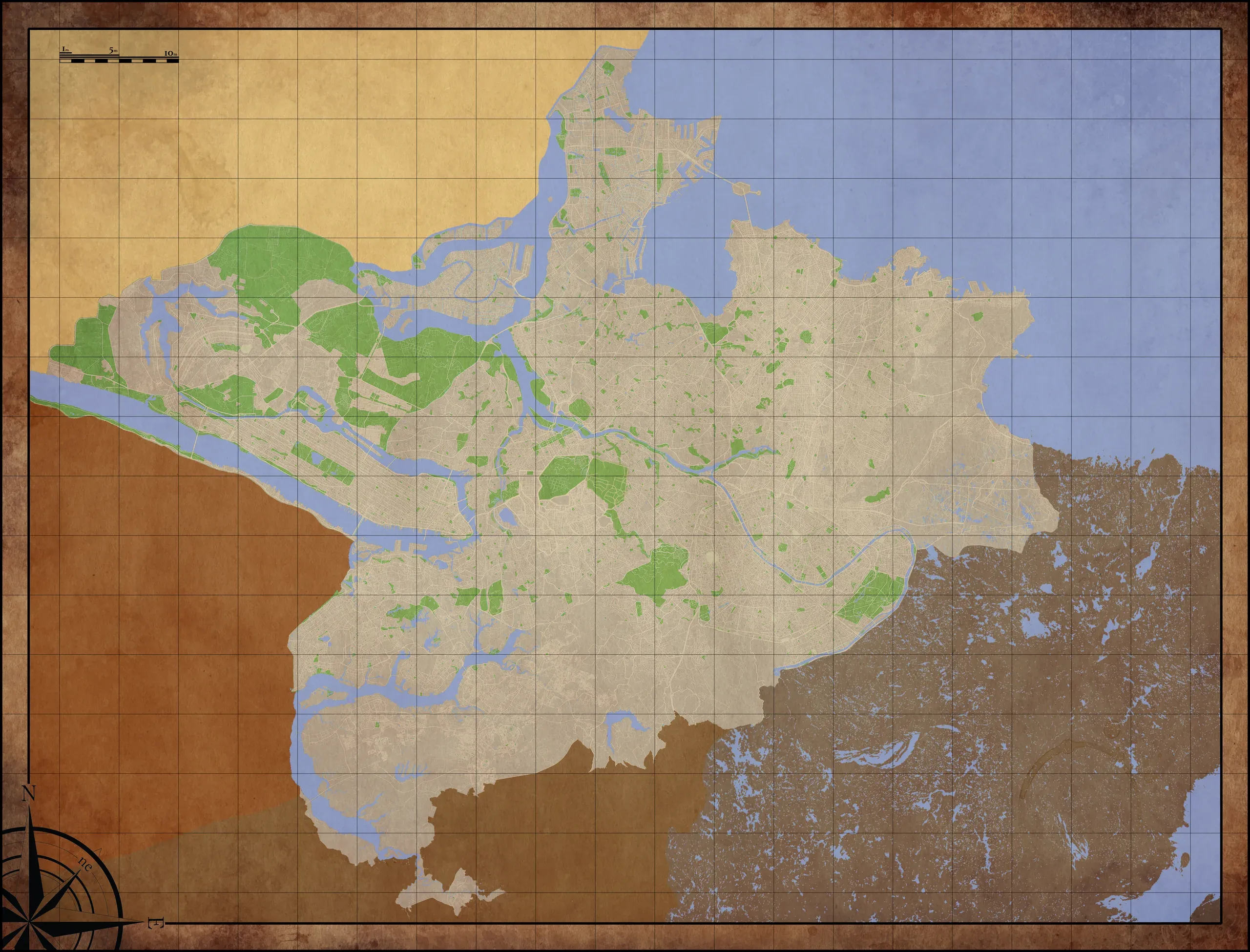
Step 1: Understanding the Scale
The map is a composite of multiple major cities, many of which have high urban densities. Let’s estimate the total land area first.
• The cities used as references (Brasilia, Copenhagen, Amsterdam, Washington, Singapore, Paris, Manhattan, Venice, and Athens) have varying population densities, but they generally fall within 5,000 to 30,000 people per square kilometer.
• The city appears highly urbanized, with dense residential and commercial districts.
• There is a mix of structured city planning (Brasilia, Washington DC) and dense organic growth (Amsterdam, Paris, Venice).
Step 2: Estimating Land Area
Using the scale bar on the map, the city spans approximately 100 km east to west and 60 km north to south.
• However, not all of this is purely urbanized; some areas are water, parks, and industrial zones.
• A rough estimate of the total urban land area is about 2,500–3,500 km².
Step 3: Estimating Population Density
Since Ravena is a megalopolis with dense mixed development, we compare it to the densest real-world cities:
• Manhattan: ~28,000/km²
• Singapore: ~8,000/km²
• Paris: ~21,000/km²
• Venice: ~7,000/km²
• Athens: ~19,000/km²
Given that Ravena combines high-rise structures, waterways, and mixed-density districts, its density likely falls in the 10,000–25,000 people per km² range.
Step 4: Calculating Population
Using this density range:
• Lower Estimate (10,000/km², 2,500 km²) → 25 million
• Higher Estimate (25,000/km², 3,500 km²) → 87.5 million
A balanced estimate might assume:
• Denser core (~30,000/km² over 1,000 km²)
• Medium-density (~15,000/km² over 1,500 km²)
• Lower-density (~5,000/km² over 500 km²)
This would give:
(30,000 • 1,000) + (15,000 • 1,500) + (5,000 • 500) = 30M + 22.5M + 2.5M = 55M
Final Population Estimate:
Ravena’s population is approximately 50–60 million denizens. This makes it one of the most densely populated megacities in Geminaea, a true hub of culture, politics, and trade.